
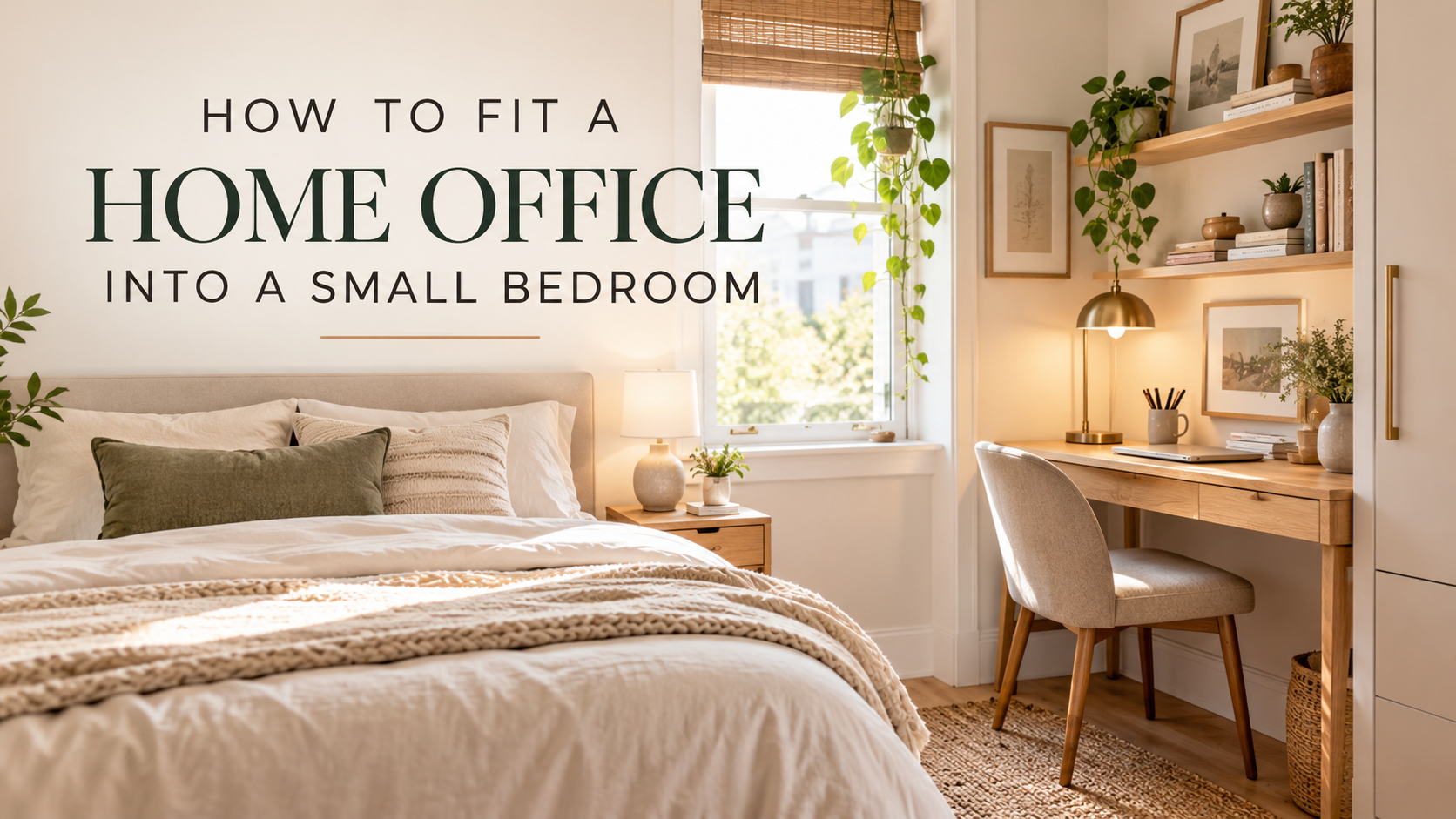
Creating a home office in a small bedroom can feel like a difficult compromise.
The bedroom should be a comfortable place to rest, while a workspace needs to support focus and productivity. When both functions share the same limited floor space, it is easy for the room to feel crowded or for work to become visually present all day.
But a bedroom office does not need to take over the room.
With careful desk placement, compact furniture and a few simple boundaries between work and rest, even a small bedroom can support both functions comfortably.
Here are practical ways to fit a home office into a small bedroom without making the space feel like an office with a bed squeezed into it.
- Start With the Bedroom, Not the Office
- Look Beside a Window
- Use a Narrow Desk
- Consider the Space Beside the Bed
- Use the Wall Above the Workspace
- Choose a Chair That Disappears Into the Setup
- Keep Work Equipment Easy to Put Away
- Connect the Workspace to the Bedroom
- Create a Small Boundary Between Work and Rest
- Reset the Workspace at the End of the Day
- A Bedroom and Home Office Can Share the Same Space
Start With the Bedroom, Not the Office
Before adding a desk, protect the bedroom’s essential functions.
Make sure you can still move comfortably between the door, bed, closet and windows. Avoid placing office furniture in the main walking path simply because there happens to be an empty wall.
The bed will usually remain the largest piece of furniture in the room, so establish its position first.
Then look at the space that remains and identify where a compact workspace can fit naturally.
The goal is to add an office to a functioning bedroom rather than redesigning the entire bedroom around a desk.
Look Beside a Window
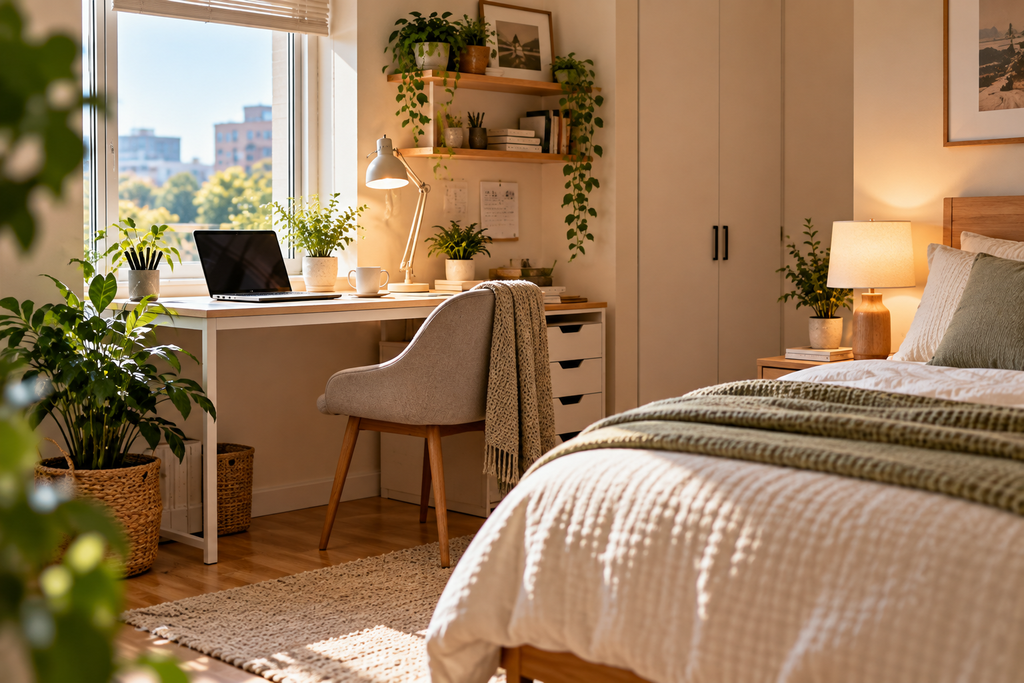
The area beside a bedroom window can be an excellent place for a small desk.
Natural light can make the workspace feel brighter and more comfortable while reducing the sense that another large piece of furniture has been added to the room.
Placing the desk beside the window rather than directly in front of it can also help reduce screen glare.
Be careful not to block the window with tall shelves or oversized furniture. Preserving daylight benefits both the workspace and the bedroom.
Use a Narrow Desk
A bedroom office rarely needs a full-size office desk.
If you mainly work on a laptop, a relatively shallow desk may provide all the surface area you need while leaving more room for circulation.
Measure desk depth as carefully as width.
In a small bedroom, reducing the depth of a desk can sometimes make a bigger difference than reducing its width because it keeps more of the floor and walking path open.
A simple desk with clean lines can also blend into the bedroom more easily than bulky office furniture.
Consider the Space Beside the Bed
In particularly small bedrooms, the workspace may need to use an area that normally holds another piece of furniture.
A compact desk beside the bed can sometimes serve as both a workspace and an oversized bedside table.
A lamp, phone charger or book can remain accessible when the desk is not being used for work.
This approach reduces the number of separate pieces of furniture in the room.
However, keep the desktop relatively clear so the area can transition easily between its two roles.
Use the Wall Above the Workspace
When the desk itself needs to remain small, move some storage onto the wall.
Floating shelves can hold books, office supplies or storage boxes without requiring a separate bookcase.
A pegboard or simple wall organizer can keep smaller items accessible while freeing up desktop space.
Avoid turning the entire wall into office storage.
Leaving some visual space around shelves and organizers helps the workspace feel integrated into the bedroom rather than dominating it.
Choose a Chair That Disappears Into the Setup
A large office chair can quickly become one of the most visually dominant objects in a small bedroom.
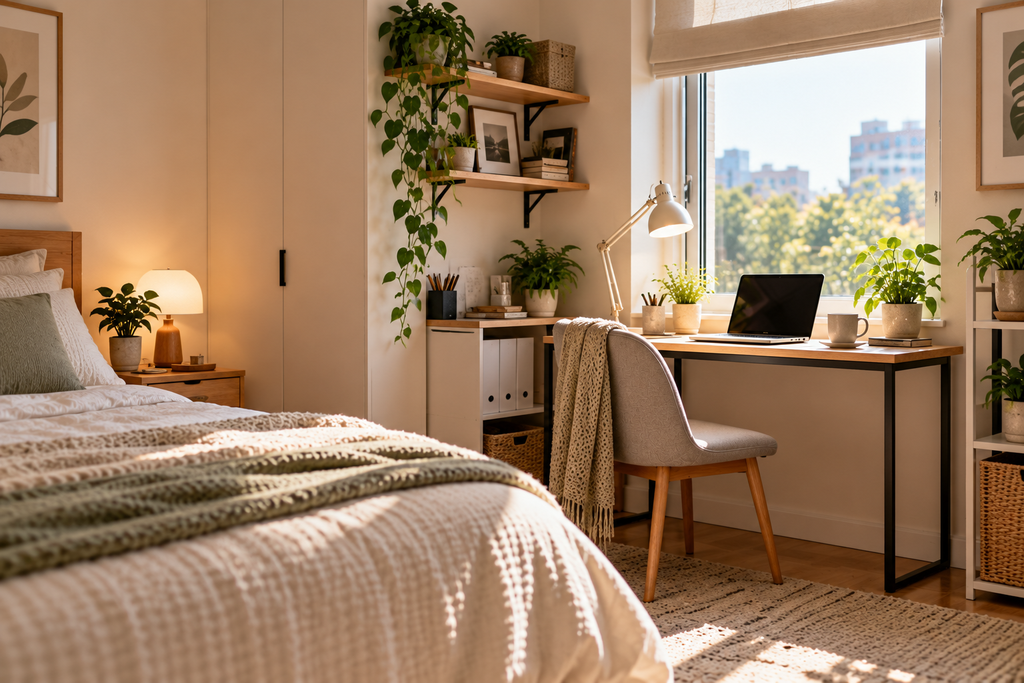
Look for a comfortable chair that can slide underneath the desk when you finish working.
A relatively simple shape and colors that coordinate with the rest of the bedroom can help the chair feel less like dedicated office equipment.
Comfort should still come first if you work for long periods.
The objective is to reduce the chair’s physical and visual footprint without sacrificing the support you actually need.
Keep Work Equipment Easy to Put Away
A bedroom can feel much less relaxing when cables, notebooks, chargers and office equipment remain scattered around after work.
Give smaller work items a specific place to go.
A desk drawer, storage box, nearby basket or small cabinet can hold accessories when they are not being used.
Cable clips or a tray underneath the desk can also keep cords from spreading across the floor or desktop.
The easier it is to put work equipment away, the easier it becomes to change the character of the room at the end of the day.
Connect the Workspace to the Bedroom
Your home office does not need to look like a separate corporate environment.
Using colors and materials already present in the bedroom can make the workspace feel like part of the room.
A natural wood desk might repeat the tone of a bed frame or dresser. Storage boxes can match the room’s neutral palette, while a desk lamp can echo other lighting fixtures.
Plants, artwork and simple decorative objects can also help connect the two areas.
Visual consistency makes a combined bedroom and office feel calmer and more intentional.
Create a Small Boundary Between Work and Rest
Even when a physical divider is impossible, a subtle boundary can help separate the two functions.
A rug beneath the desk, a different wall treatment or a focused desk lamp can visually define the workspace.
Furniture placement can also create separation. Positioning the desk so that you are not constantly looking directly at the bed while working may help the office feel more distinct.
The boundary does not need to be dramatic.
Even a small visual change can communicate that one part of the bedroom has a different purpose.
Reset the Workspace at the End of the Day
A bedroom office works best when it can stop feeling like an office.
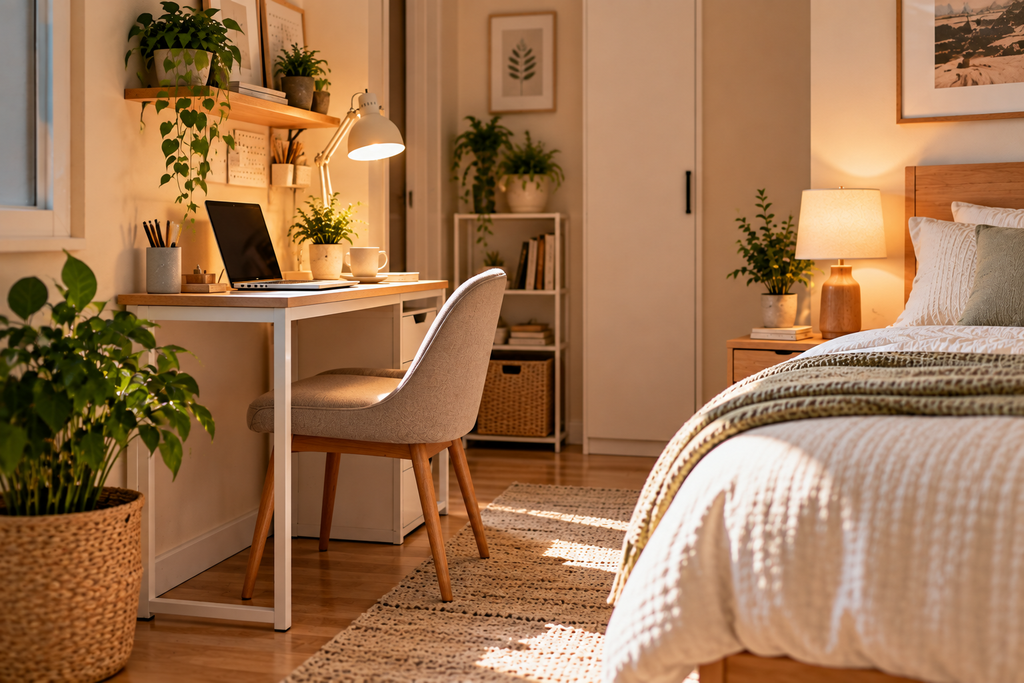
At the end of the workday, close the laptop, put away loose items and clear the desktop.
Turning off the desk lamp can also become a simple visual signal that work has finished.
If possible, avoid using the bed as an extension of the workspace for paperwork, equipment or storage.
A short reset helps restore the bedroom’s primary role as a place to relax.
A Bedroom and Home Office Can Share the Same Space
Combining work and sleep in one small room requires more thought than simply adding a desk.
Start by protecting the bedroom’s essential layout, then fit the workspace into an area that does not interfere with circulation, natural light or storage.
Choose compact furniture, use the wall efficiently and keep work equipment easy to put away.
Most importantly, create some form of separation between work time and personal time.
With a thoughtful setup, a small bedroom can provide a practical place to work without losing the calm and comfort that a bedroom should have.


Comments