
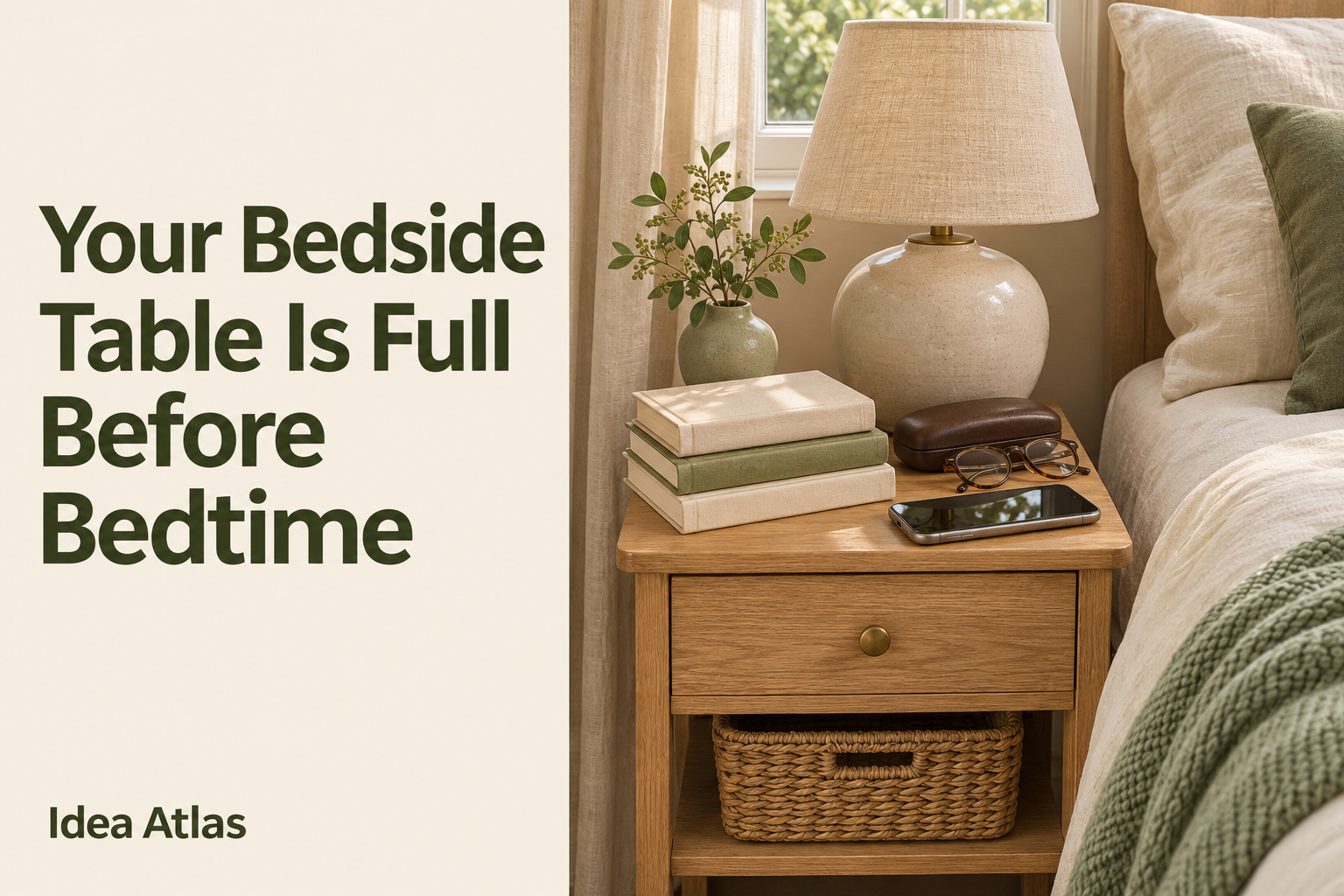
A bedside table can fit perfectly between your bed and the wall and still fail at its simplest job: giving you somewhere to put things down. The lamp is in place. A vase and a stack of books look lovely. Then bedtime arrives, and your glasses end up on the book you are trying to open.
Before replacing the table with a bigger one, check how much of its surface is actually usable. Small bedside table organization starts with what you do from bed, not with how many accessories fit into a photograph. A useful top can look pleasantly lived-in and still have room for the next thing in your hand.
Leave a place to put something down
Look at the table before you start your evening routine. Is there a clear spot where you can place your phone or closed book without moving anything else? A narrow gap behind a lamp is technically empty, but it may be awkward to reach. Several tiny spaces between objects may be less useful than one clear patch near the bed.
Try the test with your real objects. Set down your glasses in their case, then your phone, then whatever else normally arrives at bedtime. Notice which item makes you start rearranging. That moment tells you more than an idealized rule about how empty a nightstand should look.
For example, a lamp, decorative bowl, vase, and three display books may leave no convenient place for the paperback you are currently reading. Moving the vase to another room and the spare books to a shelf could solve that specific problem without changing the furniture.
The useful space is the part you can reach and use without rearranging the table.
Give the top a small set of jobs
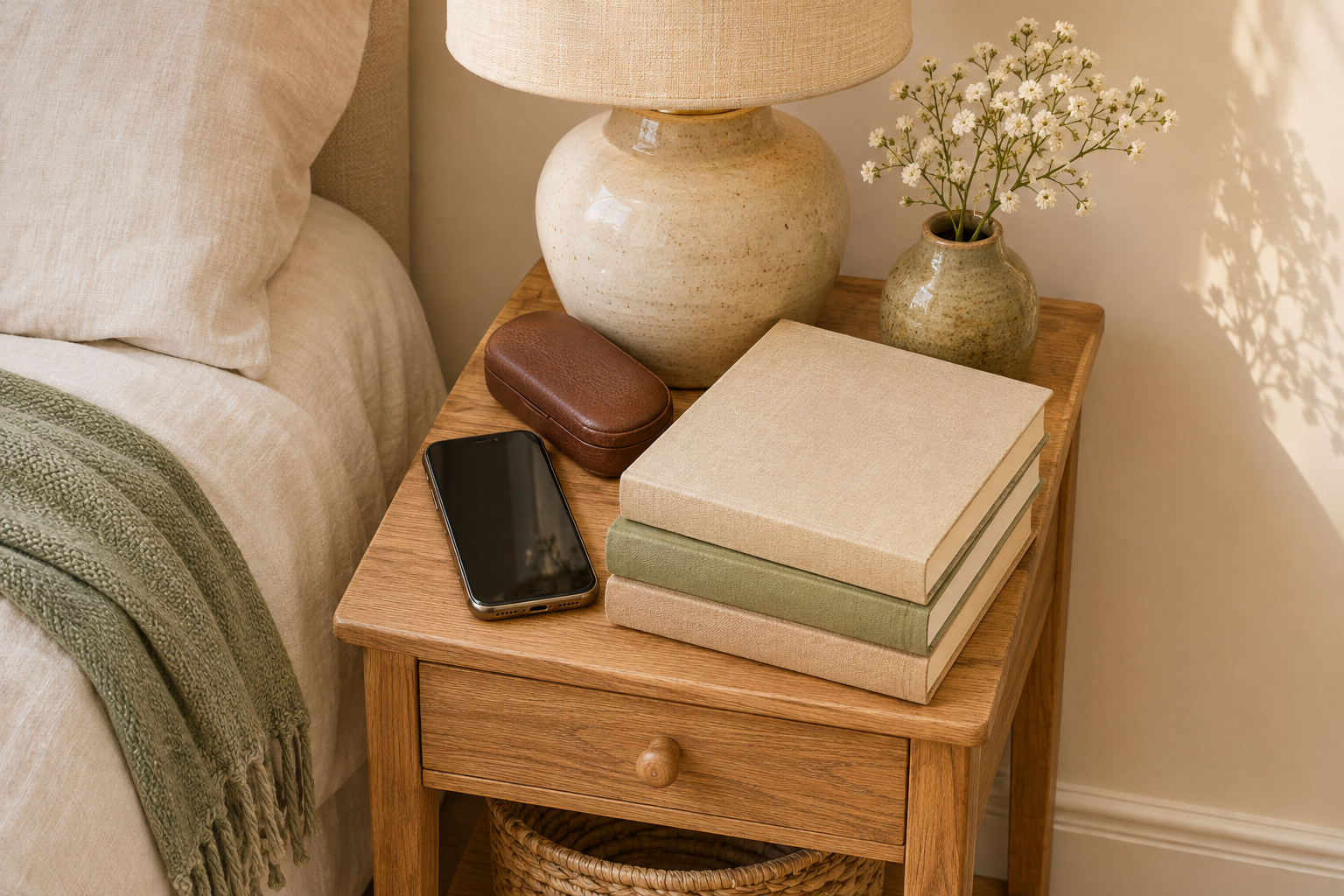
Choose the items you actually need within easy reach. Your list might include a reading light, glasses, and a book. Someone else may need an alarm clock or other essential equipment. There is no correct number of objects, and a sparse surface should never take priority over something you need.
Separate those daily needs from the things that have simply accumulated. Spare notebooks, finished books, and decorative objects do not all need the closest position. Keep a favorite object if it matters to you, but give it a deliberate place after the everyday tasks work.
IKEA’s bedside-table guidance likewise starts with what you want nearby at night and notes the role of drawers and shelves in keeping the top clearer. Apply that idea to the furniture you already own before shopping.
A tray can help small loose items stay together. It can also use up your entire clear patch. Test one you already have with the items inside it; do not assume that containing clutter automatically creates more usable space.
Check the lamp above the tabletop too
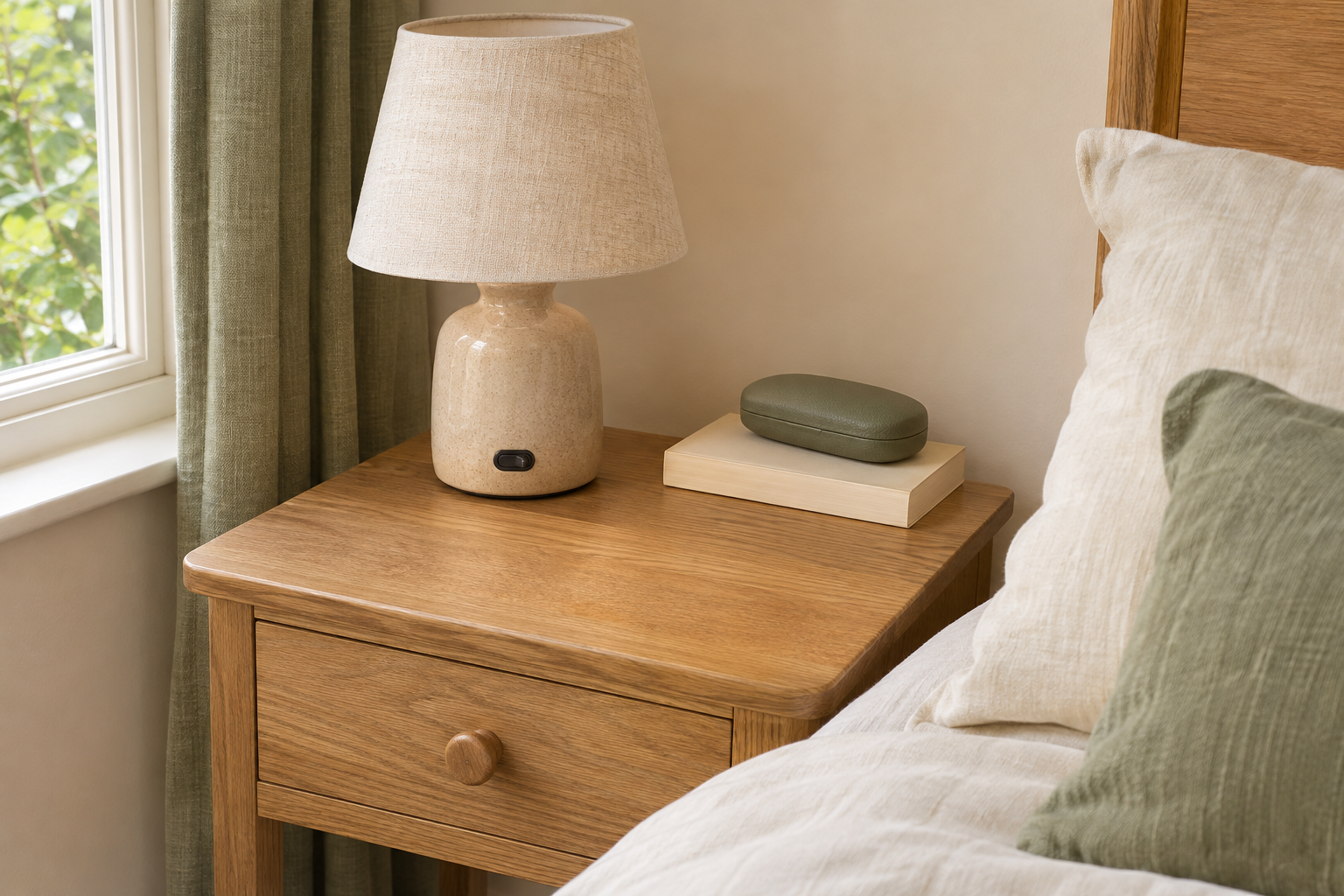
The lamp’s base is only part of the fit. A broad shade can sit over the very spot where your hand needs to pass. The switch may be hidden behind other objects, or the light may shine into your eyes when you sit up to read. A compact base does not guarantee a practical bedside arrangement.
Pottery Barn’s lamp-and-table guide considers the lamp’s scale, shade, and height together with the way the light will be used. For your own setup, check those relationships from the bed instead of judging them only while standing in the doorway.
With the lamp securely supported, see whether a small change of position makes the switch and clear surface easier to reach. Keep the whole base on a stable surface and follow the lamp’s instructions. Do not balance it on books or push it toward an edge to manufacture a little more room.
A shade projecting beyond its base is normal; overhang alone is not proof that the lamp is wrong. The question is whether this particular combination gets in your way. A large lamp can work well if you need little else on the table.
Judge the lamp and the landing space together, including the room your hand needs.
Use lower storage for things that can wait
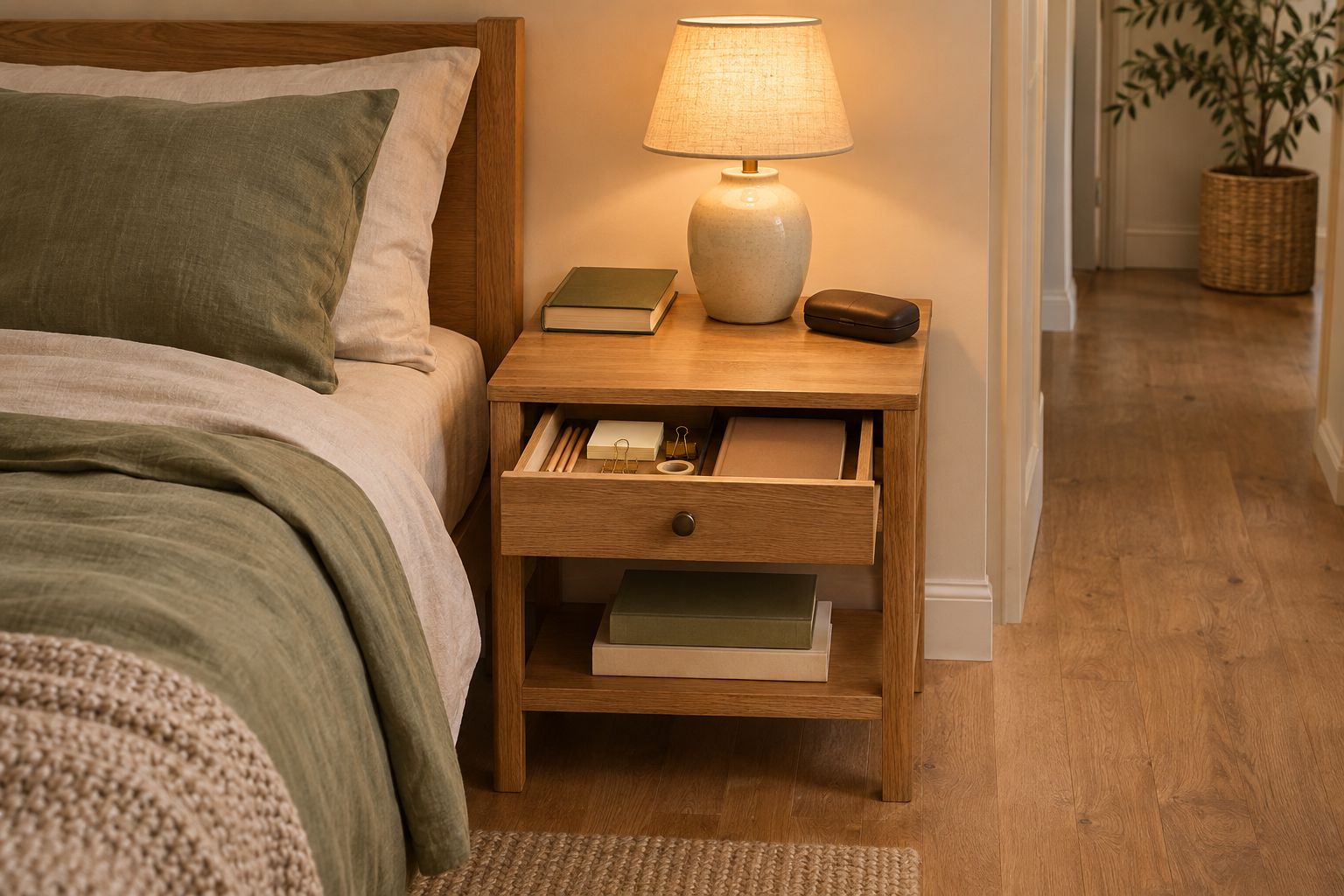
A drawer or lower shelf can take the objects you do not need to grab immediately. Keep the current book nearby and move the reading backlog below. Put spare stationery together instead of letting individual pieces spread across the top. Give each group an accessible home so clearing the surface does not become a nightly shuffle.
Check the storage in use, too. Open the drawer and take something out. If bedding catches on the handle or you must shift the whole table to reach a shelf, that space is less convenient than it first appears. You may need a different arrangement rather than another container.
Closed storage is not automatically better. An open shelf may be easier for you to use, while a drawer may suit items you prefer out of sight. Keep whichever option supports your routine. If a bedside item has specific storage or operating requirements, follow those instead of hiding it for a cleaner photograph.
Test the reach from your usual position
Sit or lie in the position you normally use when reaching for the light or your glasses. Can you find the switch and pick up the item comfortably? A clear surface still does not help if everything sits too far behind your shoulder. Make small placement changes and repeat the ordinary movement.
Consider the height of the table relative to your own mattress and how you use the bed. A universal height rule cannot account for every mattress, posture, or access need. If you share the room, each person’s side can have a different arrangement. Matching lamps and tables are optional.
Keep the route beside the bed usable as you adjust things. Moving the nightstand outward to gain tabletop access may create a new obstruction on the floor. For the wider layout, see our guide to bed placement in a small bedroom.
A useful bedside setup combines reachable essentials, working storage, and a clear route beside the bed.
Try the arrangement for a few evenings
Begin with a small change: remove one decoration, relocate the spare books, or change where the glasses live. Use the setup through your usual evening and morning routines. Look for repeated friction, such as moving the same bowl every night or losing a charging cable behind the table.
Keep cables out of the walking route and clear of moving drawers, following the relevant device instructions. If changing the lighting eventually seems necessary, consider its switch access, stability, and light quality as well as its footprint. Wall-mounted lighting involves mounting and, depending on the fixture, electrical work; it is not a universal quick fix.
Sometimes the table really is too small for your essential items. A larger surface may be the sensible choice if the room can accommodate it. But first find out what space you actually need. The goal is a bedside table that has somewhere ready for your things when you go to bed.

Comments