
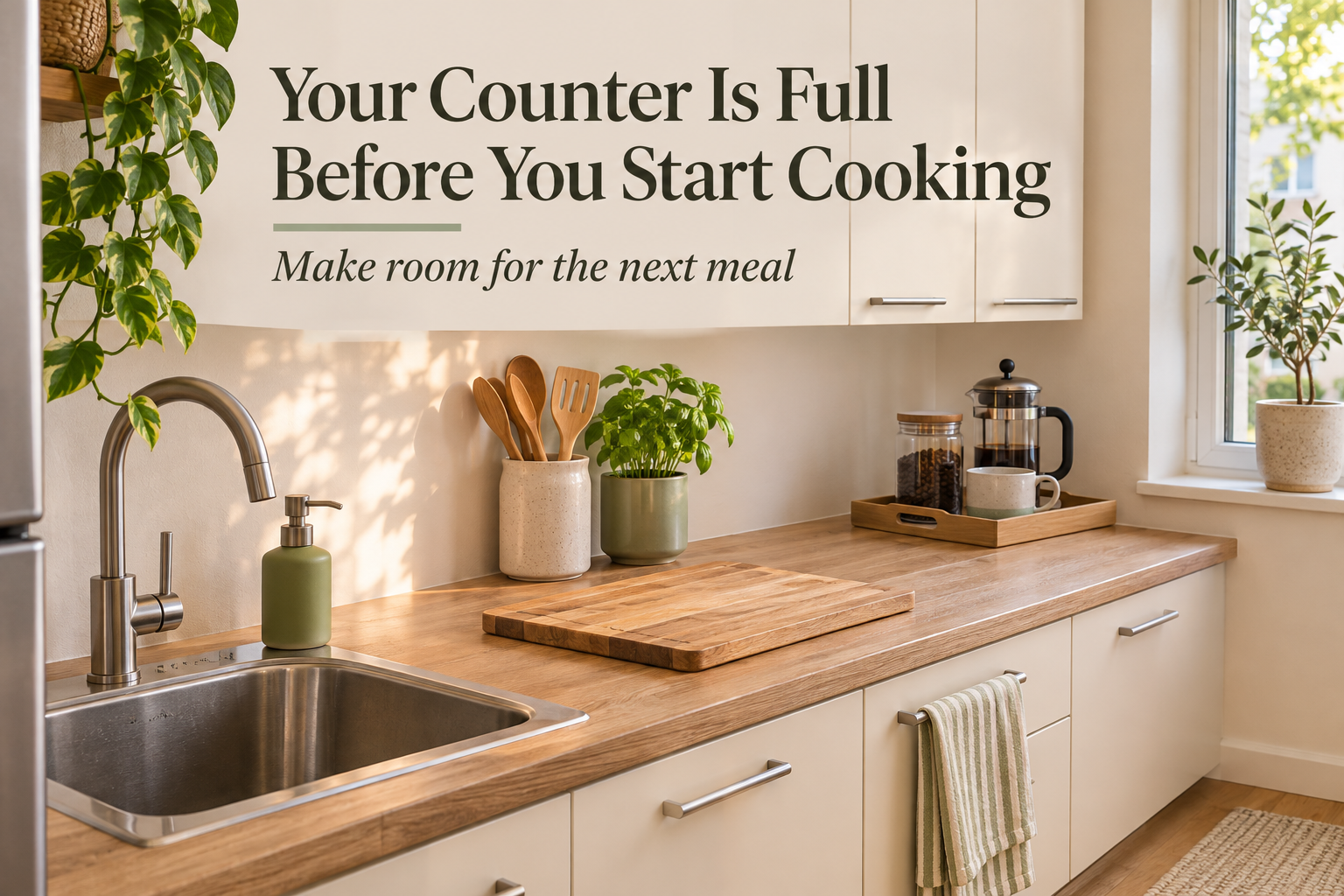
You set out a cutting board, then move the coffee jar. The jar goes beside the toaster, so the toaster moves too. Before you have washed a vegetable, you have already rearranged the kitchen.
A small counter can be genuinely too small. But sometimes the problem is that every usable patch has become a permanent parking place. Before buying another organizer, test whether you can leave one practical preparation space ready for the next meal.
This is a layout test, not a rule that every appliance must disappear. A heavy mixer you use daily may deserve its place. The aim is to reduce the things you have to move each time you cook.
Start With Your Cutting Board, Not Another Storage Bin
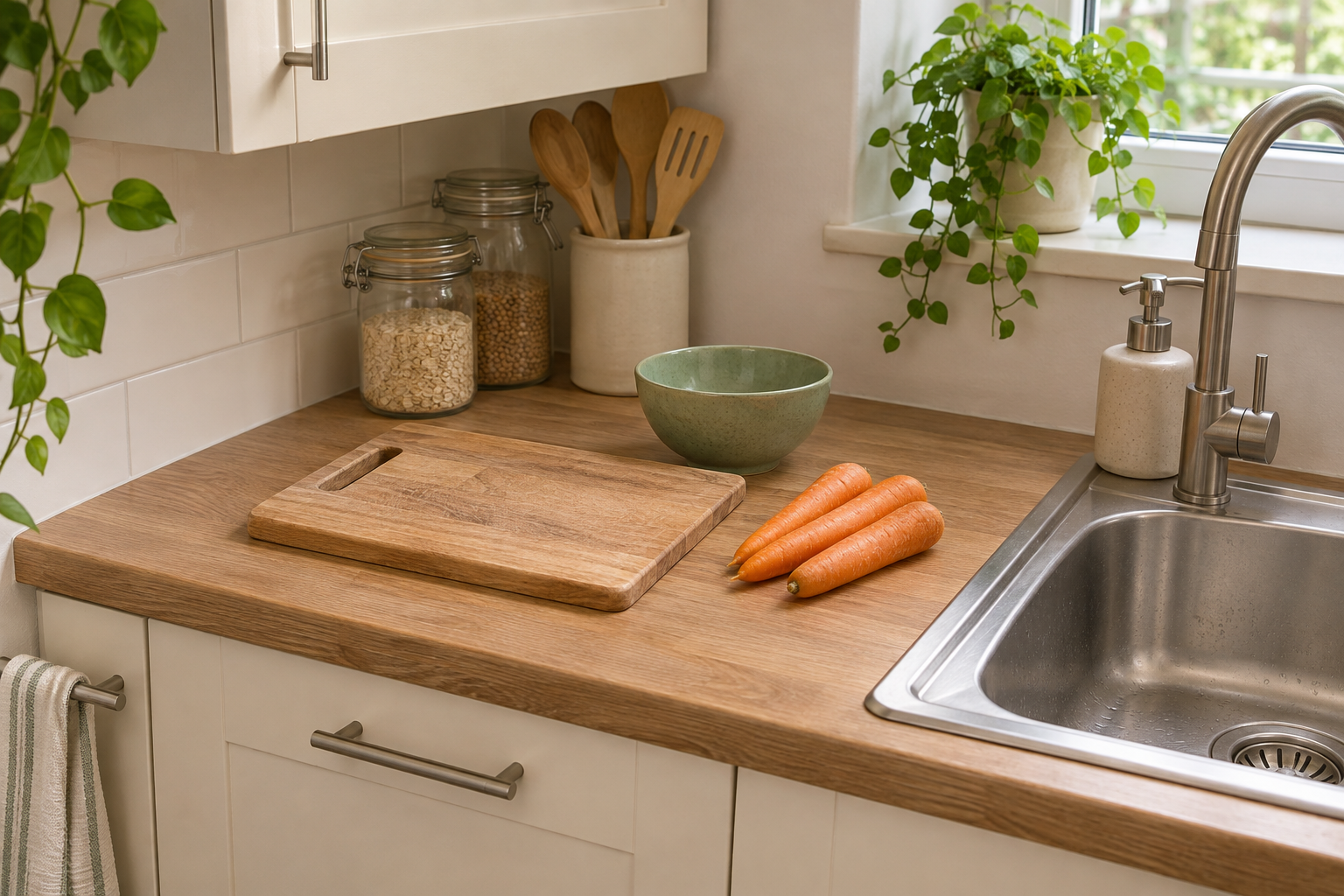
Choose a meal you regularly make. Put your usual board, bowl and ingredients on the counter as though you were about to prepare it. Leave room to work comfortably without reaching over a sink, a hot appliance or a crowded edge.
There is no single clearance measurement that suits every kitchen or person. Use your real equipment and movements. If the board only fits diagonally between other objects, that is a useful warning: the counter may be storing too much for the work you want to do there.
Once you have found a workable spot, keep that patch free of permanent storage. An empty stretch of counter is doing a job when it lets you begin cooking without a reshuffle.
Use your everyday board and bowl to test the space you need for one familiar meal.
Decide What Earns a Permanent Place
Look at the objects competing with that preparation area. Separate them into three groups:
- Used most days: keep these easy to reach, especially if moving them is awkward or unsafe.
- Used occasionally: consider a nearby cupboard only if you can lift and retrieve them comfortably.
- Waiting for somewhere else: mail, spare packaging and items that belong in another room should not quietly become kitchen fixtures.
Frequency is only part of the decision. Weight, mobility, available cupboard space and the manufacturer’s operating clearances matter too. Do not tuck a hot appliance into a cupboard to use it there, or run it while crowded by other objects. Let equipment cool before moving or storing it, and follow its instructions.
If an appliance has to stay out, design around it. Moving a few light jars may be a more useful change than repeatedly lifting a heavy machine. Check that the appliance door or lid can still open and that cords stay clear of water, heat and walking routes.
Give One Routine a Small Home
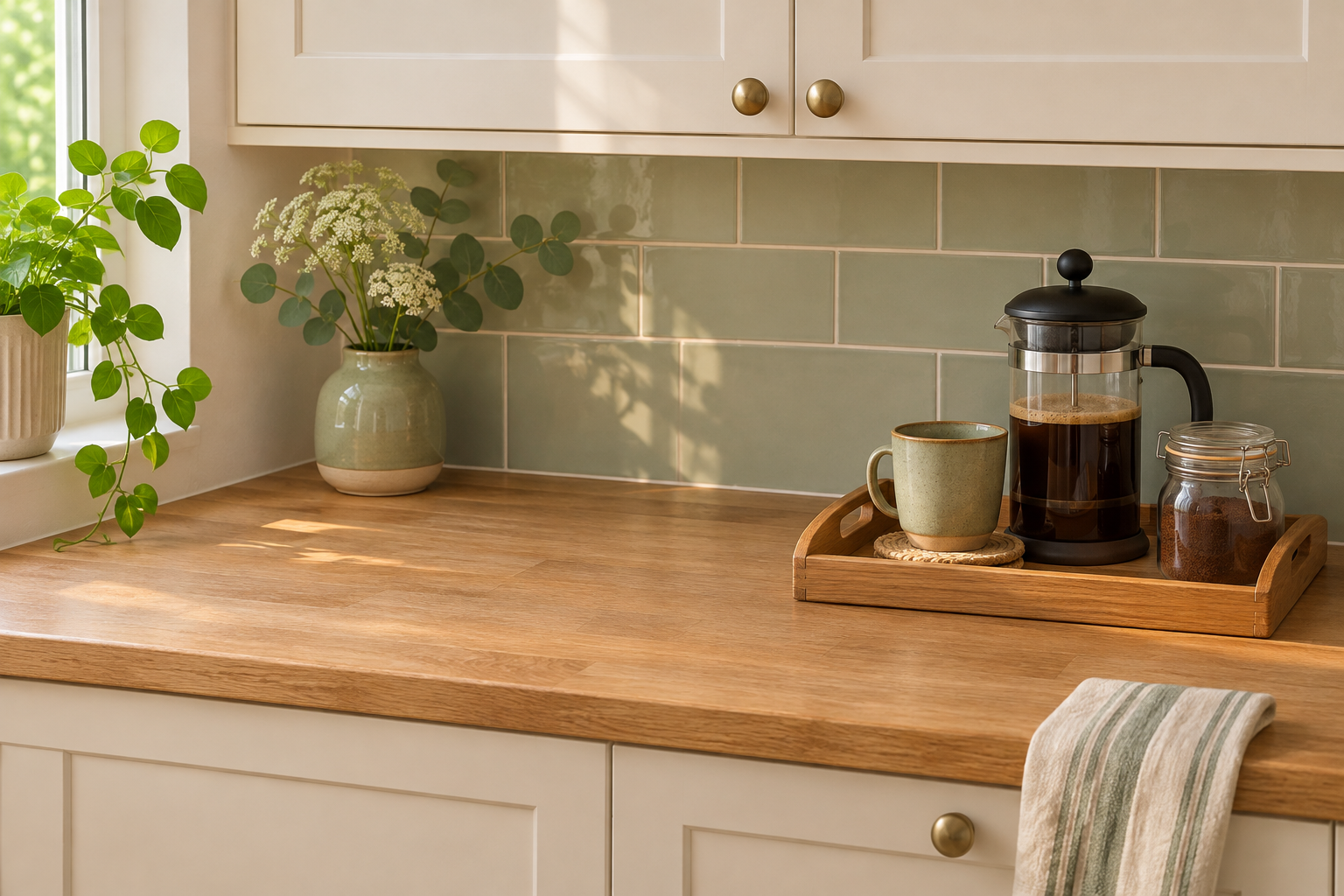
A coffee corner can work well at one end of the counter, away from the area where you usually chop and mix. Group the things that belong to that routine rather than spreading them across the whole worktop.
A tray can make a small collection easier to move, but it does not create extra counter space. Choose one that holds only what you need. If it becomes a landing place for unrelated objects, remove the extras rather than buying a larger tray.
Keep the group light enough to move safely. Do not carry hot drinks or a plugged-in appliance on a tray. A cupboard shelf for spare mugs or refills can help, provided those items remain accessible.
A compact coffee group at the end of the counter leaves the central preparation patch available.
Check Where the Displaced Items Will Actually Go
Clearing the counter is not a success if everything lands on the dining table. Before moving an item, identify its new home and test the full action: open the door, take it out, use it and put it back.
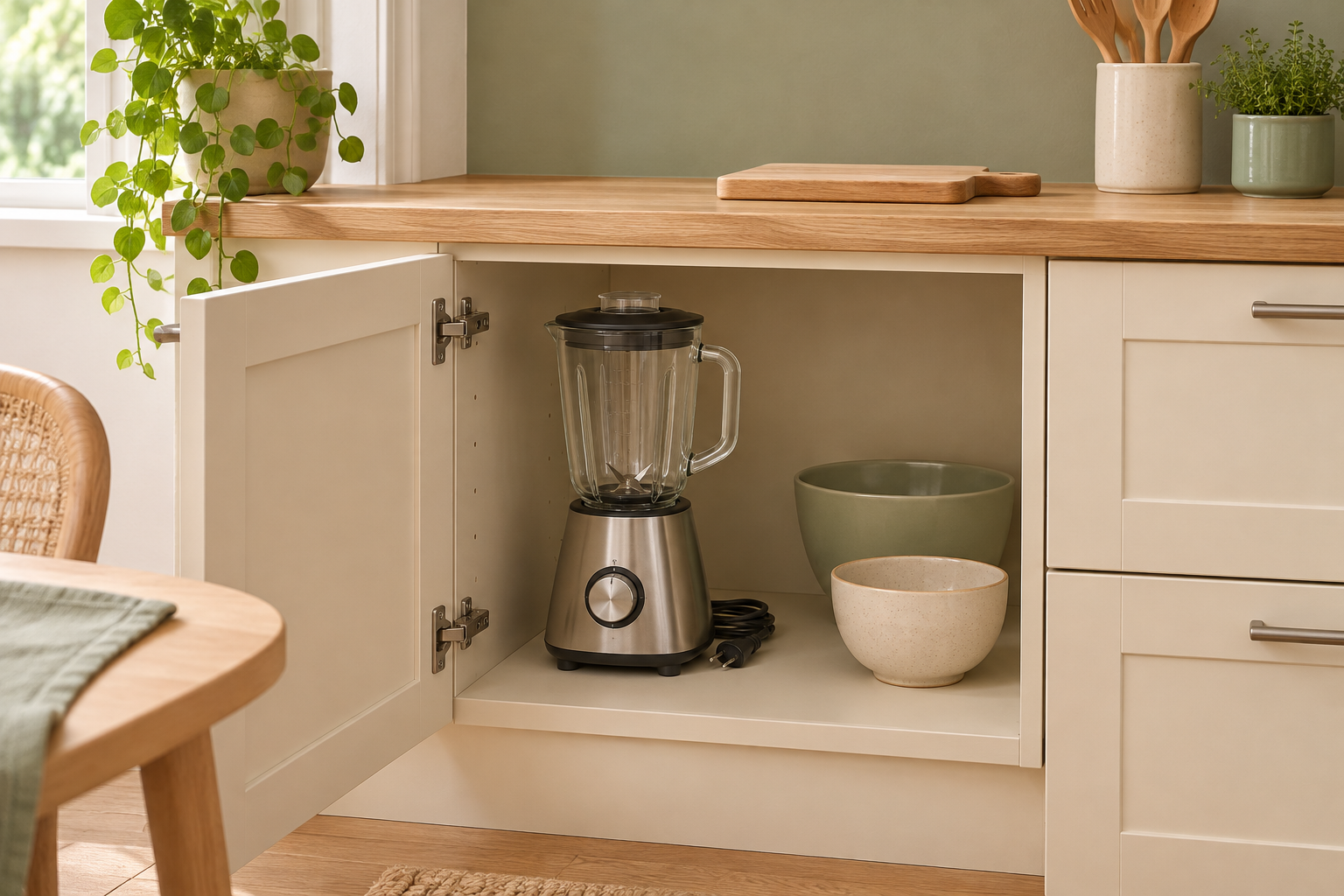
A low shelf may suit an occasional lightweight appliance. A drawer may suit loose utensils. Neither helps if the shelf is already full or the drawer cannot close. Avoid piling heavy equipment overhead or placing it where you must climb or twist awkwardly to reach it.
Do the same check for dishes. If the drying rack fills the only usable counter, could you put clean, dry dishes away before preparing a meal? A smaller or folding rack may suit some households, but only if it can handle the dishes you actually wash. Do not assume that a smaller rack is automatically a better one.
Store occasional equipment only where you can retrieve it without emptying the shelf first.
When Rearranging Is Not Enough
Some kitchens simply do not have enough safe work surface for the way they are used. After removing unnecessary storage, you may still need an additional preparation surface. Test the footprint before buying a cart or table: include the walking route, cupboard doors and the space you occupy while working.
A cart needs a stable, suitable worktop and secure wheels if it will be used for preparation. It should not block an exit or an essential appliance. A removable board over a sink is only an option if it fits securely and is designed for that use; it also removes access to the sink while in place. Never treat a stove as spare storage or preparation space.
For a renter, a freestanding solution may be easier to reverse than wall-mounted storage. Check your lease before drilling. You may also find that preparing ingredients in stages is more practical than squeezing in another piece of furniture.
Try the Layout Through a Few Real Meals
Use the new arrangement for a few ordinary meals, not just a tidy photograph. Notice what you move first, what gets left out and whether washing up restores the preparation patch.
- Can you set down the board without relocating another object?
- Are everyday items still easy and safe to reach?
- Can cupboards and appliance doors open normally?
- Does the dining table stay free of displaced kitchen clutter?
- Can you reset the space without a complicated sorting routine?
If the same object keeps returning to the counter, reconsider its storage spot. It may need a better home, or it may genuinely deserve to stay out. The useful result is a kitchen that works for your next meal, even if it does not look completely empty.
For ideas elsewhere in the apartment, see space-saving storage ideas for small apartments. If organizers themselves are eating up storage capacity, try the shelf-and-basket fit check.
Images are AI-generated illustrations of layout ideas, not measured before-and-after results.


Comments