
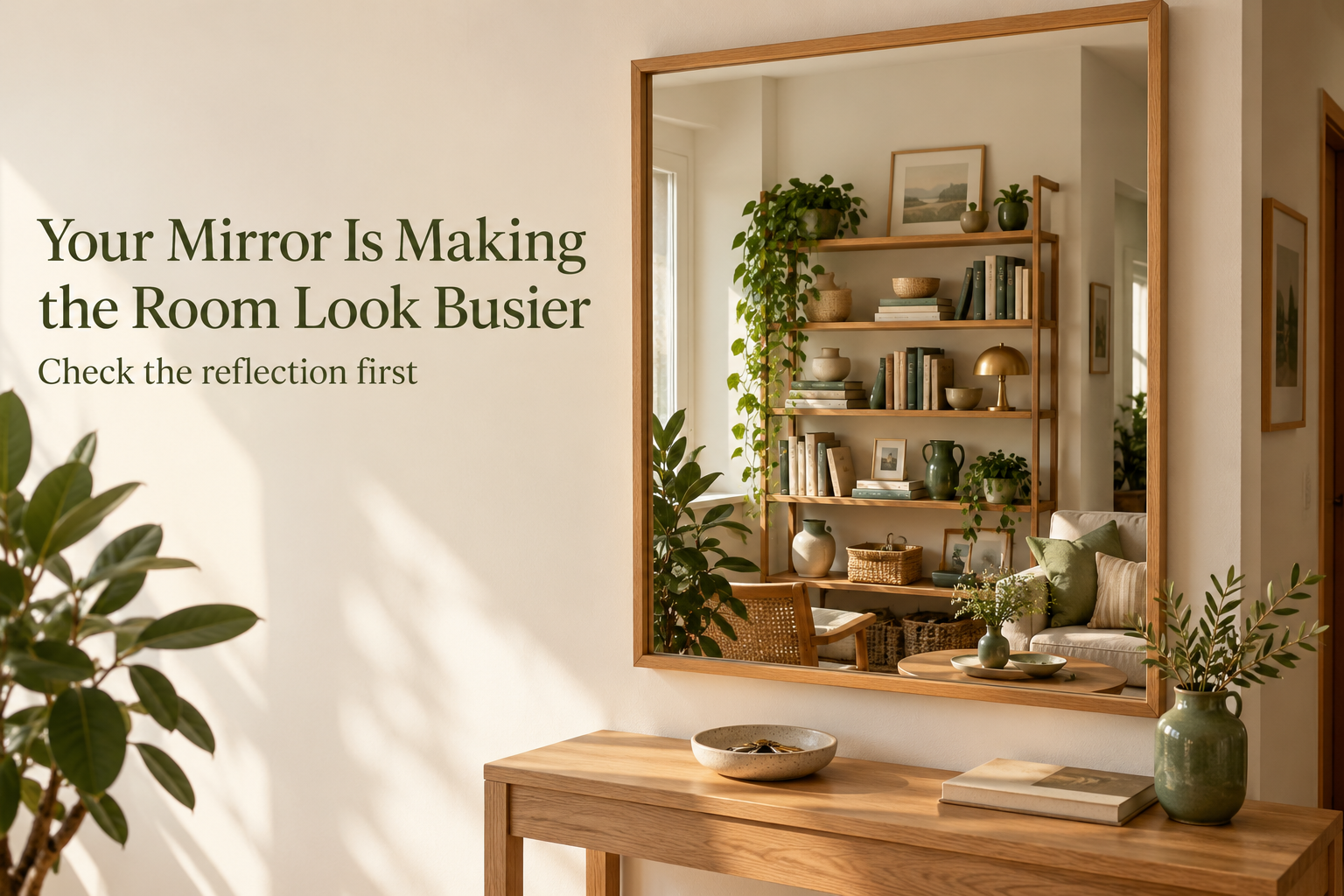
A mirror can make a small living room feel more open. It can also give you a second view of the laundry basket, the crowded sideboard, and the cables beside the television. If the room feels busier since you added one, look inside the frame before changing anything else.
Good mirror placement in a small living room starts with what you will see reflected from the places you actually use. A quiet wall, a favorite picture, or a pleasant window view may be more useful than the largest mirror that fits. You may be able to improve the view without replacing any furniture.
Notice what the mirror repeats
Stand where you usually enter the room and glance toward the mirror. What catches your attention first? Perhaps it is the window. Perhaps it is a pile of mail you would otherwise barely notice.
The problem is not necessarily the objects themselves. A living room can hold books, toys, and everyday belongings without feeling wrong. But a mirror introduces another view of them. When that reflection sits beside an already detailed corner, the combination may feel more crowded than you intended.
Pottery Barn’s mirror-hanging guide makes a useful starting point: choose a wall that faces something you want to see reflected. Treat that as a question about your room, rather than a requirement to create a perfect display.
Leave the room as it normally looks while you assess it. A placement that works only after you hide every everyday item may be frustrating to live with.
Check the reflected view from the places where you actually spend time.
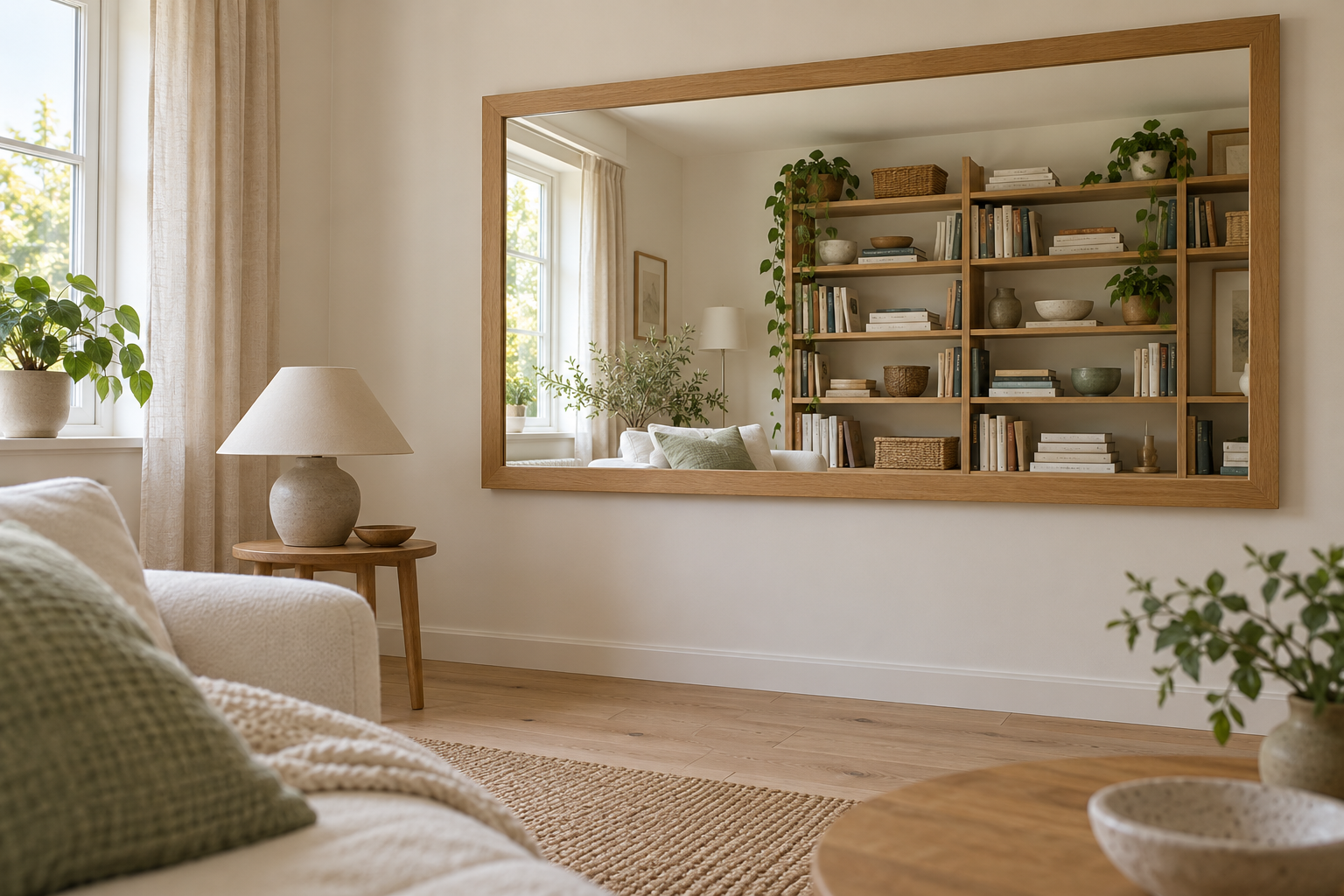
Check the view from the doorway and the sofa
A mirror can look lovely from directly in front of it and distracting from your usual seat. Start with two viewpoints: the entrance you use most and the spot where you sit to relax. If another chair gets daily use, include that too.
From each position, ask whether the reflection adds something you enjoy or pulls your attention toward something you would rather leave in the background. A television that appears in the glass may matter more from the sofa than from the doorway.
For an existing mirror, take a quick photo from each spot. You are documenting the reflection, not trying to photograph a beautifully styled room. Compare those views before deciding whether a change is worth the effort.
For a possible new location, a small, lightweight handheld mirror can help preview the direction of the reflection when held at the proposed position and angle. It will not show the full view of a larger mirror. A paper template can check the frame’s size, but cannot tell you what it will reflect. Do not balance a heavy mirror on furniture for a trial.
Choose a calm view that already exists
Look for a part of the room you would happily see again. That might be a softly colored wall, one piece of art, a plant against a plain background, or a window with an appealing outlook. Calm does not have to mean empty.
A busy bookshelf may be a perfectly good reflection if you love its color and texture. The question is whether you enjoy seeing it from your usual seat. There is no need to conceal a collection simply because a decorating rule favors blank space.
Try comparing candidate walls before buying a different mirror. Moving a wall mirror to another suitable location can change its view; rotating a rectangular mirror from portrait to landscape usually changes the crop, not the direction it faces. A freestanding model may allow a different angle, but only within its intended, secure setup.
If every available position reflects something distracting, a picture or an unfilled wall may suit that spot better. A small room does not need a mirror on every spare wall.
A quieter reflection can come from an ordinary wall, a picture, or a window edge.
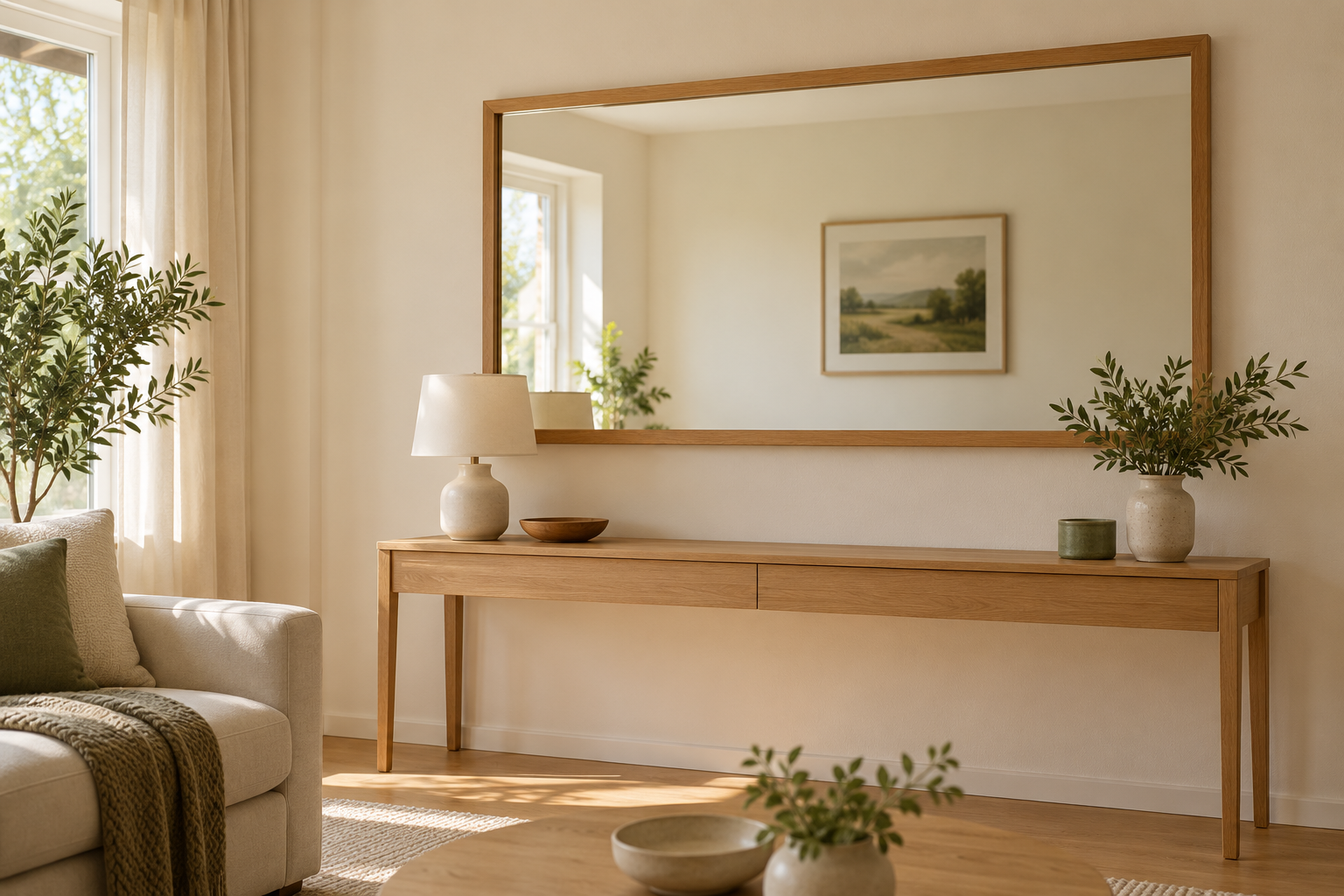
Test a window reflection in daylight and after dark
A window is worth considering, but “opposite the window” is not a complete placement plan. Check what the glass actually shows from the sofa: an outdoor view, a neighboring wall, the curtain edge, or a bright patch of sky.
Visit the room at the times you normally use it. If reflected sunlight feels uncomfortable at your seat, that placement needs another look. You do not have to accept glare for the sake of a brighter-looking photograph.
Then check after dark with your usual lamps on and curtains or blinds in their normal position. A reflection that felt gentle during the day may now put a bright bulb or television screen in your line of sight.
Consider privacy as well. From the doorway or another shared area, can the mirror reveal a part of the room that was previously tucked out of view? In a studio, that may include a sleeping or changing area. Judge the setup by the way you live, not just its daylight appearance.
Let the reflection guide the size and height
Once you have a promising location, consider how much of the view you want to include. A wider mirror might bring a distracting doorway into the reflection alongside the window you like. A smaller one may frame the quieter portion more easily.
Height changes the view too. Check it from both standing and seated positions rather than choosing a height only because the frame lines up neatly with nearby furniture. An attractive arrangement on the wall still needs to work from the sofa.
Keep the surrounding wall in mind. A decorative frame can be the feature you want, while a simpler one may feel more comfortable beside patterned curtains or artwork. Neither is automatically better for a small room.
Make sure the proposed location leaves doors, curtains, switches, and walking routes usable. A good reflection is not worth an awkward obstacle.
Check the evening reflection as well, including at a practical spot such as an entryway.
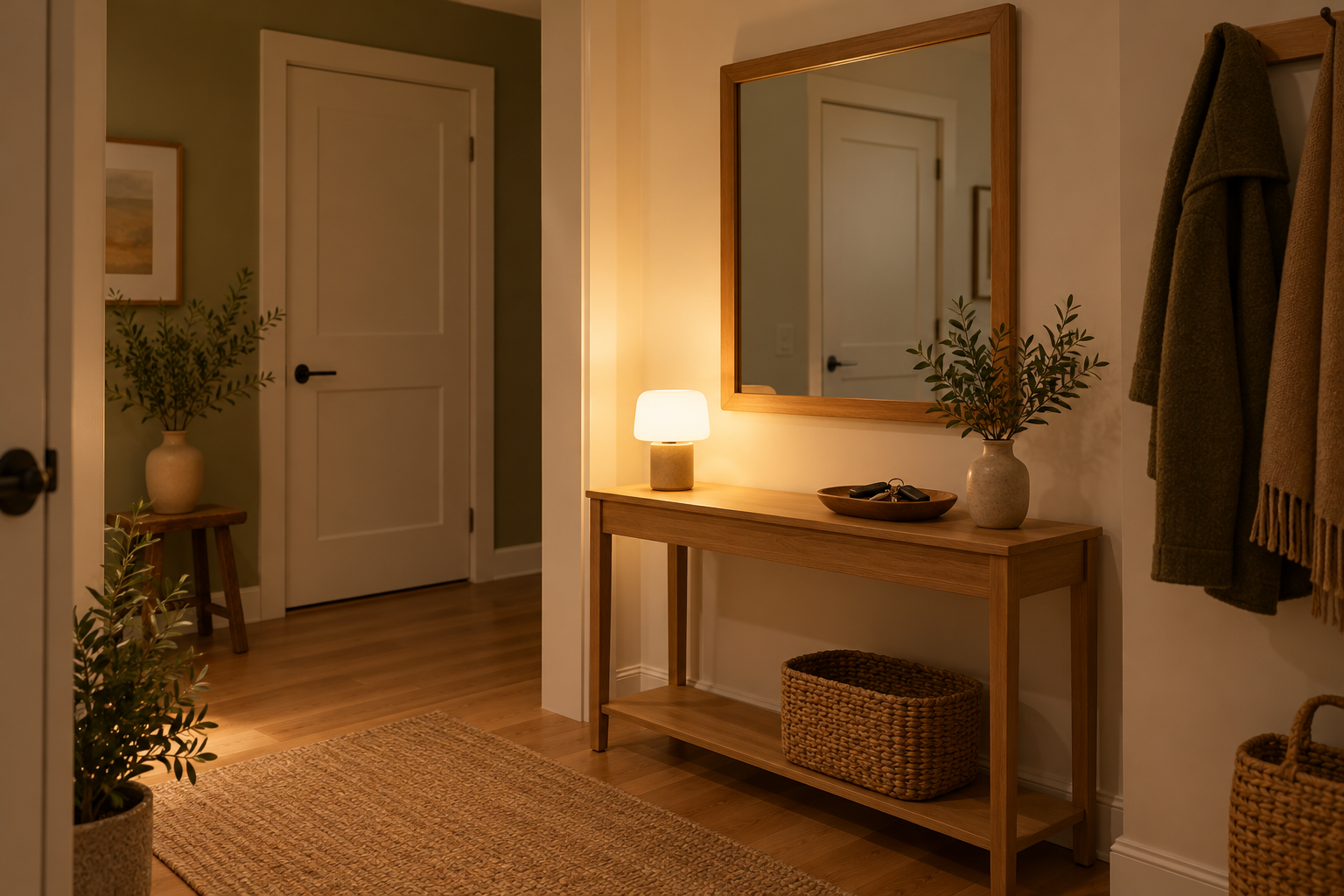
Keep useful mirrors useful, and mount them safely
An entry mirror has a practical job. If it is where you check your appearance before leaving, that convenience may matter more than a perfectly quiet reflection. Keep the useful position unless the reflected view genuinely bothers you.
For any move or new installation, follow the instructions for that exact mirror, including permitted orientations and required fixings. IKEA’s NYSJÖN installation instructions, for example, call for qualified wall mounting and fittings suited to the wall material with sufficient holding power. They are a product-specific example, not instructions for every mirror.
Do not assume a wall mirror can safely lean, or that a freestanding model needs no anchoring. Follow the manufacturer’s requirements and use a qualified installer when needed. If you rent, check permission before drilling.
The best next step is simple: look at your current mirror from the doorway, then sit down. If you like both views, leave it alone. If one feels busy, decide what you would prefer to see before choosing a new position.

Comments